

Hey there! As a supplier of raw material intermediates, I've been in the thick of this industry for quite a while. One question that often pops up is, "What are the by - products generated during raw material intermediates production?" Well, let's dive right in and explore this topic.
First off, it's important to understand what raw material intermediates are. These are substances that are produced during the synthesis of a final product. They're like the building blocks that are used to create more complex chemicals. And just like any manufacturing process, the production of raw material intermediates comes with its own set of by - products.

Types of By - Products
Inorganic By - Products
A lot of the time, inorganic by - products are formed during chemical reactions. For example, when we're dealing with reactions that involve metal catalysts or inorganic reagents, salts can be a common by - product. Let's say we're synthesizing a certain intermediate using a metal chloride as a catalyst. During the reaction, the metal might react with other components in the reaction mixture to form metal salts. These salts can vary in their properties and uses. Some might be recycled and reused in other industrial processes, while others might need to be disposed of properly to avoid environmental issues.
Organic By - Products
Organic by - products are also quite prevalent. In organic synthesis, side reactions can occur, leading to the formation of different organic compounds. For instance, in a reaction where we're trying to form a specific intermediate through a substitution reaction, there could be competing reactions that result in the formation of isomers or other related organic compounds. These by - products can sometimes be similar in structure to the desired intermediate, which can make separation a bit of a challenge.
Impact of By - Products
Environmental Impact
The by - products generated during raw material intermediates production can have a significant environmental impact. Inorganic salts, if not managed properly, can contaminate water sources. They can increase the salinity of water, which can be harmful to aquatic life. Organic by - products, especially those that are persistent and bioaccumulative, can also pose a threat to the environment. For example, some organic compounds can accumulate in the food chain, affecting the health of animals and humans in the long run.
Economic Impact
On the economic side, dealing with by - products can add to the production costs. Separation and purification processes are often required to isolate the desired intermediate from the by - products. These processes can be energy - intensive and require the use of additional chemicals. However, if the by - products can be recycled or sold, they can also represent an additional source of revenue. For example, some inorganic salts can be sold to other industries that use them as raw materials.
Examples from Our Production
Let me share a couple of examples from our production line. We produce Rifaximin|CAS 80621 - 81 - 4, which is an important raw material intermediate. During its synthesis, we've noticed the formation of some organic by - products. These by - products are the result of side reactions that occur under certain reaction conditions. We've had to invest in advanced separation techniques to ensure that the final product is of high purity.
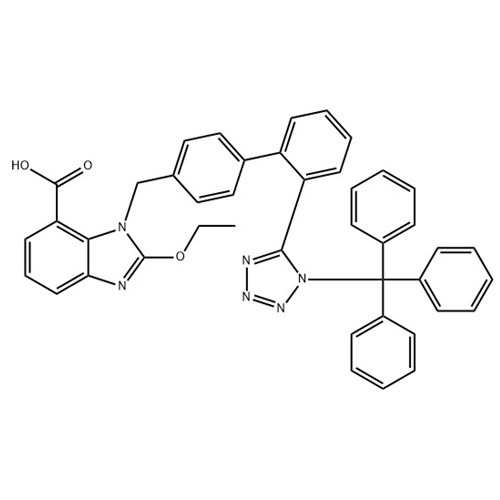
Another product we deal with is Trityl Candesartan CAS#139481 - 72 - 4. In its production, inorganic salts are among the by - products. We've developed a recycling process for these salts, which not only reduces our environmental impact but also saves us some money on raw material costs.
We also produce (Z)-Methyl2 - ethoxy - 3 - ((2'-(N'-hydroxycarbaMiMidoyl)biphenyl - 4 - yl)Methyl)-3H - benzo[d] IMidazole - 4 - carboxylate CAS#147403 - 65 - 4. The production of this intermediate involves a series of complex reactions, and we've encountered a variety of by - products, both organic and inorganic. By carefully studying the reaction mechanisms, we've been able to optimize the process to minimize the formation of these by - products.
Managing By - Products
Separation and Purification
One of the key steps in dealing with by - products is separation and purification. We use a variety of techniques such as distillation, chromatography, and crystallization. Distillation is great for separating compounds based on their boiling points. Chromatography, on the other hand, can separate compounds based on their affinity for a stationary phase. Crystallization is useful for obtaining pure compounds from a solution.
Recycling and Reuse
As I mentioned earlier, recycling and reusing by - products can be a great way to reduce costs and environmental impact. We're constantly looking for ways to recycle the inorganic salts and organic by - products we generate. For example, some of the organic by - products can be used as starting materials for other reactions in our production line.
Conclusion
In conclusion, the production of raw material intermediates is a complex process that comes with its fair share of by - products. These by - products can have environmental and economic impacts, but with proper management, we can minimize these effects. At our company, we're committed to sustainable production practices, and we're always looking for ways to improve our processes to reduce the formation of by - products and make the most of them when they do occur.
If you're in the market for high - quality raw material intermediates, we'd love to talk to you. Whether you have questions about our products, our production processes, or how we manage by - products, we're here to help. Reach out to us for a detailed discussion and let's explore how we can work together to meet your needs.
References
- Smith, J. Chemical Reactions in Raw Material Intermediate Production. Journal of Industrial Chemistry, 2018.
- Johnson, A. Environmental Impact of By - Products in Chemical Manufacturing. Environmental Science Review, 2020.
- Brown, C. Recycling and Reuse of By - Products in the Chemical Industry. Chemical Engineering Magazine, 2019.