



4-Chloropyridine hydrochloride chloride CAS 7379-35-3 is a regulatory chemical that can be used to inhibit the population growth of microbes. It functions as a biotransforming agent and is typically used in the production of other substances, such as pharmaceuticals and plastics. 4-Chloropyridine hydrochloride chloride CAS 7379-35-3 is not readily biodegradable and has been shown to be toxic to ciliates, but it may still have some use in the treatment of certain bacterial infections. The compound's molecular descriptors include a constant value of -0.8, an isomer count of 1, and a molecular weight range between 112 and 142.
Why Choose us
Excellent Team
The company has hired senior experts and PhDs in the field of biochemical synthesis in China to lead the guidance, and has a leading core team consisting of senior engineer Zeng Fanrong with a master's degree and multiple undergraduate research and development personnel.
Quality Services
Team members possess multilingual skills and are able to adapt to the diverse needs of the international market, establishing stable cooperative relationships with global clients.
Quality Assurance
We produce merchandise of the highest possible standard. Possessing the technology and skills to reach the requirements of our clients, we ensure that the merchandise produced reflects our commitment to providing our clients with a fast, reliable and cost-effective service without compromising on quality.
Related Products

Ethyl 4-(1-Hydroxy-1-Methylethyl)-2-Propyl-Imidazole-5-Carboxylate Cas#124750-51-2
CAS: 144689-93-0
MF: C12H20N2O3
MW: 240.3
EINECS: 1592732-453-0

(1S)-2,2-Difluorocyclopropane-1-Carboxylic Acid
(1S)-2,2-difluorocyclopropane-1-carboxylic acid 97%, CAS#: 1883301-82-3, Cat ID: L14727, BUILDING BLOCKS, AChemBlock

2-ethylcyclopentanone 2-ethylcyclopentan-1-one CAS: 4971-18-0 Molecular Formula: C7H12O
![(Z)-乙基-2-乙氧基-3-((2'-(N'-羟基氨基甲酰基)联苯-4-基)甲基)-3H-苯并[d]咪唑-4-羧酸酯 CAS#1397836-41-7](https://www.huarongpharma.com/uploads/41662/-z-ethyl-2-ethoxy-3-2-n-hydroxycarbamimidoyl57c99.jpg "product-1-1")
(Z)-Ethyl-2-Ethoxy-3-((2'-(N'-HydroxycarbaMiMidoyl) Biphenyl-4-Yl) Methyl)-3H-Benzo[D]
CAS: 1397836-41-7
MF: C26H26N4O4
MW: 458.51
![乙基-2-乙氧基-1-[[(2-(1H四唑-5-基)联苯-4-基-)甲基] CAS#139481-58-6](https://www.huarongpharma.com/uploads/41662/page/ethyl-2-ethoxy-1-2-1htetrazol-5-yl-biphenyl-40c71a.jpg "product-1-1")
Ethyl -2-Ethoxy-1-[[(2-(1Htetrazol-5-Yl)Biphenyl-4-Yl-) Methyl] CAS#139481-58-6
CAS: 139481-58-6
MF: C26H24N6O3
MW: 468.51

Ethyl 4-(1-Hydroxy-1-Methylethyl)-2-Propyl-Imidazole-5-Carboxylate Cas#144689-93-0
CAS: 144689-93-0
MF: C12H20N2O3
MW: 240.3
EINECS: 1592732-453-0

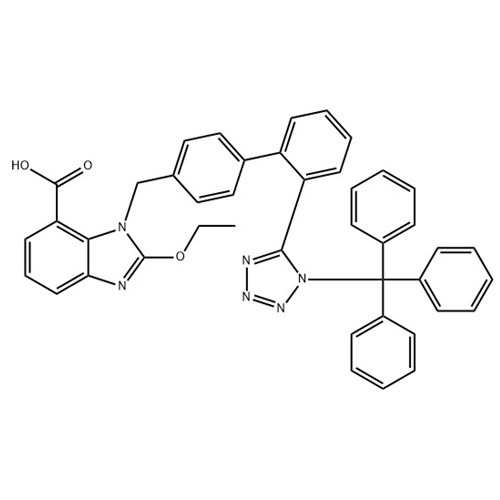
Trityl Candesartan Cilexetil CAS#170791-09-0
CAS: 170791-09-0
MF: C52H48N6O6
MW: 852.97
EINECS: 605-586-7

SECTION 1: First-aid Measures
If inhaled
Move the victim into fresh air. If breathing is difficult, give oxygen. If not breathing, give artificial respiration and consult a doctor immediately. Do not use mouth to mouth resuscitation if the victim ingested or inhaled the chemical.
Following skin contact
Take off contaminated clothing immediately. Wash off with soap and plenty of water. Consult a doctor.
Following eye contact
Rinse with pure water for at least 15 minutes. Consult a doctor.
Following ingestion
Rinse mouth with water. Do not induce vomiting. Never give anything by mouth to an unconscious person. Call a doctor or Poison Control Center immediately.
Most important symptoms/effects, acute and delayed Indication of immediate medical attention and special treatment needed, if necessary
SECTION 2: Fire-fighting Measures
Suitable extinguishing media
Use dry chemical, carbon dioxide or alcohol-resistant foam.
Specific hazards arising from the chemical
Special protective actions for fire-fighters
Wear self-contained breathing apparatus for firefighting if necessary.
SECTION 3: Accidental Release Measures
- Personal precautions, protective equipment and emergency procedures
Avoid dust formation. Avoid breathing mist, gas or vapours.Avoid contacting with skin and eye. Use personal protective equipment.Wear chemical impermeable gloves. Ensure adequate ventilation.Remove all sources of ignition. Evacuate personnel to safe areas.Keep people away from and upwind of spill/leak.
- Environmental precautions
Prevent further spillage or leakage if it is safe to do so. Do not let the chemical enter drains. Discharge into the environment must be avoided.
- Methods and materials for containment and cleaning up
Collect and arrange disposal. Keep the chemical in suitable and closed containers for disposal. Remove all sources of ignition. Use spark-proof tools and explosion-proof equipment. Adhered or collected material should be promptly disposed of, in accordance with appropriate laws and regulations.
SECTION 4: Handling and Storage
- Precautions for safe handling
Handling in a well ventilated place. Wear suitable protective clothing. Avoid contact with skin and eyes. Avoid formation of dust and aerosols. Use non-sparking tools. Prevent fire caused by electrostatic discharge steam.
- Conditions for safe storage, including any incompatibilities
Store the container tightly closed in a dry, cool and well-ventilated place. Store apart from foodstuff containers or incompatible materials.
What is the Synthesis Method of 4-Chloropyridine Hydrochloride Chloride CAS 7379-35-3?


Background and Overview
4-Chloropyridine hydrochloride chloride CAS 7379-35-3 is an important fine chemical intermediate widely used in the fields of pesticides, pharmaceuticals, and daily chemicals. With the deepening of application research, the demand for 4-Chloropyridine hydrochloride chloride CAS 7379-35-3 has rapidly increased both domestically and internationally. Many foreign companies have come to China to seek 4-Chloropyridine hydrochloride chloride CAS 7379-35-3 products, making it a hot product in the intermediate industry. 4-Chloropyridine hydrochloride chloride CAS 7379-35-3 is a representative compound and an important organic synthesis intermediate.
Applications
4-Chloropyridine hydrochloride chloride CAS 7379-35-3 is the main component for synthesizing a food protease inhibitor. This drug can be used to treat advanced cancer and is currently undergoing phase I clinical trials. It is also an intermediate for synthesizing certain drugs such as antiarrhythmic drugs, anticoagulants, and anti-arthritis drugs.
Synthesis
There are many synthesis methods for 4-Chloropyridine hydrochloride chloride CAS 7379-35-3, but these methods all have various disadvantages, such as low yield, multiple steps, complex post-treatment, and the use of some extremely dangerous drugs that are difficult to handle in industrial production. This article presents a method for synthesizing 4-Chloropyridine hydrochloride chloride CAS 7379-35-3 using 4-aminopyridine as the raw material. 4-aminopyridine is dissolved in methanol, saturated with hydrogen chloride gas, and then sodium nitrite is added in batches to prepare 4-Chloropyridine hydrochloride chloride CAS 7379-35-3. The experimental principle can be represented by the following equation:
- Experimental Procedure:
In a 100ml four-necked flask equipped with mechanical stirring, a thermometer, and a reflux condenser, 4-nitropyridine-N-oxide (1.75g), 95% ethanol (62.5ml), 5% Pd/C (0.4g), and ammonium formate (4.5g) are added. The mixture is kept at 50°C for 1.5 hours, filtered to remove the solid, and the catalyst is recovered. The filtrate is distilled under reduced pressure to remove ethanol, and the residue is extracted with ethyl ether to obtain crude 4-aminopyridine. The crude product is recrystallized with benzene-petroleum ether to obtain white needle-like 4-aminopyridine (1.02g) with a yield of 86.8%.
In a 50ml three-necked flask equipped with a condenser and a thermometer, 4-aminopyridine (2.0g) and anhydrous methanol (9.0ml) are added. The mixture is cooled in an ice-water bath, and hydrogen chloride gas is continuously passed for about 2 hours. The flask is then kept in the ice bath, and 2g of sodium nitrite is added in three portions within 3 hours. The mixture is then slowly heated, and after the internal temperature reaches 62°C, it is filtered while hot and recrystallized with ethanol to obtain white 4-Chloropyridine hydrochloride chloride CAS 7379-35-3 solid (2.97g) with a yield of 93.1%.
What's the Role of 4-Chloropyridine Hydrochloride Chloride CAS 7379-35-3 in Reaction Mechanisms?
4-Chloropyridine hydrochloride chloride CAS 7379-35-3 in reaction mechanisms act as temporary species that are formed and consumed during the reaction process.
In more detail, 4-Chloropyridine hydrochloride chloride CAS 7379-35-3 are molecules or ions that are produced in one step of a reaction mechanism and consumed in a subsequent step. They are not present in the overall balanced chemical equation for the reaction, as they are formed and used up during the reaction process. This is what distinguishes them from reactants, which are consumed, and products, which are formed in a chemical reaction.
4-Chloropyridine hydrochloride chloride CAS 7379-35-3 play a crucial role in reaction mechanisms as they help to explain how a reaction occurs at a molecular level. They are often involved in the rate-determining step of a reaction, which is the slowest step in a reaction mechanism and determines the overall rate of the reaction. By studying the 4-Chloropyridine hydrochloride chloride CAS 7379-35-3 and the steps in which they are involved, chemists can gain a better understanding of the reaction mechanism and how to control or manipulate it.
For example, in the reaction mechanism for the formation of sulphuric acid, the sulphur trioxide (SO3) that is formed in the first step is an intermediate. It reacts with water in the second step to form sulphuric acid, which is the final product. By understanding the role of this intermediate, chemists can control the conditions of the reaction to optimise the production of sulphuric acid.
In addition, 4-Chloropyridine hydrochloride chloride CAS 7379-35-3 can also be used to identify the pathway of a reaction. If an intermediate is detected during a reaction, it can provide evidence for a particular reaction pathway. For instance, if a certain intermediate is detected during a reaction, it can suggest that the reaction is proceeding via a certain mechanism rather than another.
In conclusion, 4-Chloropyridine hydrochloride chloride CAS 7379-35-3 are crucial in understanding and controlling chemical reactions. They provide insight into the steps of a reaction mechanism, the rate of the reaction, and the pathway of the reaction.
Company Introduction
Huarong (Guangdong) Pharmaceutical Co., Ltd. is a pharmaceutical intermediate manufacturing and production company, based on the synthesis of DPP-4 inhibitor intermediates. It comprehensively constructs a production line for active ingredients of bisamide insecticides, as well as a multifunctional production line for chiral synthesis and enzymatic synthesis of compound intermediates. Build an advanced and green comprehensive production base for pharmaceutical and pesticide intermediates.
The company was established on November 8, 2023, with a type of other limited liability company and registered in Nanxiong City, Shaoguan City. The company's project plan covers an area of 53406.97 square meters. The main building includes 5 Class A multifunctional workshops, 1 Class C workshop, 1 comprehensive building, 1 quality inspection and research and development building, as well as supporting power and environmental protection facilities. The construction of the project covers an area of 19042 square meters, with a building area of 50137 square meters and a plot ratio of 0.94.

Asked Questions
Hot Tags: 4-Chloropyridine Hydrochloride Chloride CAS 7379-35-3, China 4-Chloropyridine Hydrochloride Chloride CAS 7379-35-3 manufacturers, suppliers, Veterinary raw materials, , 4 bromopyridine hydrochloride


